
Russian from zero to C1 — written to the exam, not to an app.
Five coursebooks that follow the official TORFL levels, written by a language teacher of twenty years who also teaches them. A syllabus with an end point, not a streak counter.
Amazon · paperback and Kindle · one-to-one lessons online

Agnieszka WargośAuthor of 37 language coursebooks · 20+ years teaching · reviews & all books on Amazon →


Why the app is not working
You can recognise four hundred Russian words and still not finish a sentence
This is the most common place adult learners of Russian get stuck, and it is not a discipline problem. Recognition and production are separate skills. An app trains the first one very efficiently and barely touches the second, which is why people arrive after a year of daily practice able to read a menu and unable to ask a question.
Russian punishes this gap harder than most languages, because almost every word changes shape. Six cases, three genders, verbs that come in pairs, and motion verbs that split again depending on whether you go on foot or by vehicle, once or regularly. None of that is difficult to understand. It is difficult to use at speed — and using it at speed is exactly what an exam, or a conversation, asks for.
These books are built the other way round. Grammar arrives in the order you need it to say something, every point is drilled until it is automatic, and each level ends where the corresponding TORFL exam ends. Whether or not you ever sit the exam, that gives you something an app cannot: a finish line you can see.
The Russian Start series
Five levels, five books, one continuous path
Each is a complete course for its level, with explanations in English, exercises, model answers and a key. Work through them alone, or use them as the spine of lessons — the material is identical either way.
| Level | Book | What you can do by the end | |
|---|---|---|---|
| A1 ТРКИ A1 |
Russian A1 — Complete Beginner’s Course | Read and write Cyrillic, introduce yourself, handle shops, transport and directions, and use the present tense and the first cases with confidence. | Amazon → |
| A2 ТРКИ A2 |
Russian A2 — Complete Elementary Course | Talk about the past and the future, describe people, places and routines, and manage everyday conversations without preparing them first. | paperback → Kindle → |
| B1 ТРКИ-1 |
Russian Start B1 — Complete Intermediate Course | Hold an opinion, follow a news item, write a coherent letter, and use verbal aspect and motion verbs deliberately rather than by guesswork. | Amazon → |
| B2 ТРКИ-2 |
Russian B2 — Complete Upper-Intermediate Course | Work in Russian, read the press without a dictionary, and write formally — the level most employers and universities ask to see. | Amazon → |
| C1 ТРКИ-3 |
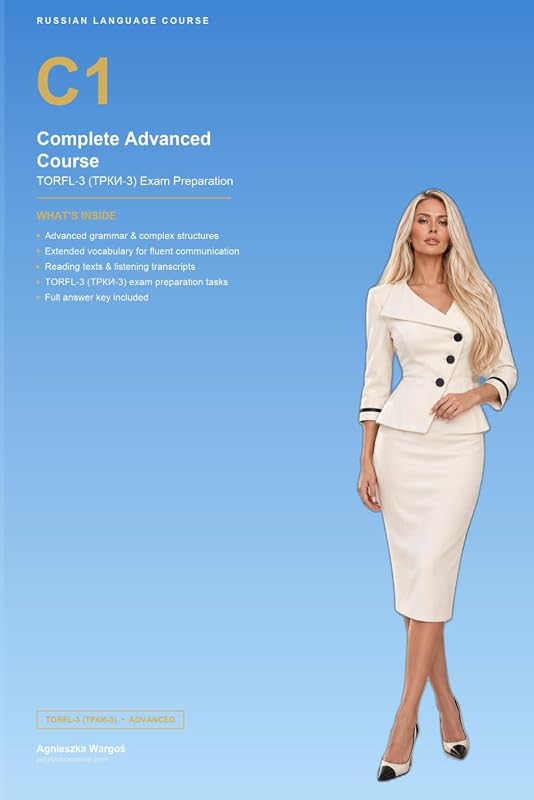
Russian C1 — Complete Advanced Course | Write and argue with precision at an advanced level, follow academic and professional Russian unassisted, and work confidently with register and nuance. | Amazon → |
Not sure which level to buy?
If you have used an app for a year, A1 is usually still the right book — it fills in the production side that recognition practice leaves empty. If you have studied formally before, start with A2. Send me a paragraph below and I will tell you honestly.
All five titles are on Amazon in paperback and Kindle. For the A1 book I recommend the paperback — you will be handwriting Cyrillic, and that is a motor skill, not a reading one.
Who these books are for
Four situations, four different starting points
The books are the same; where you begin and what we emphasise is not. If you take lessons, the first one settles this properly.
You need a TORFL certificate. For work, study or residency. Here the plan runs backwards from the exam date and the level required, and written accuracy becomes the priority from the first week.
You have been using an app for a year. You recognise a great deal and produce very little. A1 is still the right place to start — not to relearn the alphabet, but to convert what you recognise into sentences you can say.
Russian is in your family. You may understand a good deal at home and have never written a word of it. Reading and writing Cyrillic properly comes first; the spoken side you already have will then carry you quickly.
You study or work with Russian material. Historians, musicians, engineers, researchers. Getting to B2 and reading sources unassisted is a realistic goal, and it is the level worth aiming straight at.
If you want lessons as well
One-to-one, online, following the same books
Lessons are optional — the books are complete on their own. What lessons add is the part a book physically cannot do.
The first lesson is a diagnosis
You do real tasks, not a self-assessment quiz. You leave knowing your actual level, what is missing, and how long the next step takes.
Written work comes back marked
With the rule written beside each correction. In a language where every ending carries meaning, this is the fastest way to stop repeating the same error for years.
You speak from lesson one
Even at A1, and even badly at first. Producing a case ending under time pressure is a different skill from knowing the table, and only one of them is tested by real life.
Rates
From £35 per hour, lower in packages, with a £30 diagnostic first lesson. Full rates are on the pricing page; the first diagnostic lesson comes off your first package.
Send me eight sentences and I will tell you your real level
Write eight to ten sentences in Russian, at whatever level you are, and send them over. You get them back with every mistake marked, the rule beside each one, and one honest sentence about where you actually sit — and therefore which book to buy.
No fee, no sign-up. It takes me fifteen minutes and saves you from spending a year in the wrong book.
- Every mistake markedUnderlined, with the correction.
- The rule beside each oneNot just „wrong” — why.
- Your real levelA1, A2, B1, B2 or C1 — honestly.
- Which book to start withSo you do not buy the wrong one.
Common questions
Before you start
I do not know the Cyrillic alphabet. Can I still use the A1 book?
Is Russian grammar as brutal as people say?
What is TORFL and do I need it?
Are the books in English or in Russian?
How long does A1 take?
Do you teach students outside the United Kingdom?
Who wrote these books
I write the course I could not find
Twenty years of teaching taught me what goes wrong and roughly when. Learners do not stall because a language is hard; they stall because the material stops, or because it drills recognition and never asks them to produce anything. So I write courses that go all the way to the top of a level and make you speak from the first lesson.
The Russian series is the same method as my Polish and English courses: one book per level, mapped to the published standard, with everything a self-taught adult needs to work alone if that is what they prefer.
- Teaching
- Over 20 years with adults and teenagers — Russian, Polish and English.
- Coursebooks
- 37 titles: Russian A1–C1, Polish A1–C2, Polish for English Speakers A1–B2, English A1–C2, Business Polish and GCSE Polish.
- Research
- Peer-reviewed work on second language acquisition and online language pedagogy.
Also teaching Polish and English
The Polish course runs A1 to C2, and English Start covers A1 to C2 for adult learners. Same approach, same authorship.
Start at A1 and actually finish it
One book, one level, a visible end. The cheapest way to find out whether this method suits you costs the price of a paperback.